ServicesReverse Osmosis
Reverse Osmosis Systems in The Colony
We install under-sink reverse osmosis systems for cleaner drinking and cooking water, and we repair existing units that have slowed down or started tasting off. We test your water first, then tell you whether fresh filters will do or the system has reached the end of its useful life.
What Reverse Osmosis Does at Your Kitchen Sink
Reverse osmosis forces tap water against a thin-film composite membrane, a sheet so fine that most dissolved solids cannot get through it. Lead picked up from older fixtures and solder is among what stays behind, along with nitrates, fluoride and many trace contaminants. The concentrate is rinsed off to the drain, and the treated water fills a small pressurized tank under the sink until you open the dedicated faucet.
An RO unit serves a single faucet, not the whole house. What you pour into a glass, a coffee maker or a pasta pot passes through the membrane, while the shower and washing machine get ordinary tap water. If chlorine taste in every tap is the real complaint, whole-home filtration may be the better first step, and we will say so.
Most RO problems trace back to a clogged prefilter, a tank that has lost its air charge or a membrane past its life. Each of those parts can be swapped on its own, so a slow or bad-tasting system often needs service rather than a new unit.
What Our RO Work Includes
- Water test before any recommendation
- We check total dissolved solids, hardness and chlorine at your tap. The numbers tell us how hard the membrane will work and which prefilters it needs.
- Standard under-sink installation
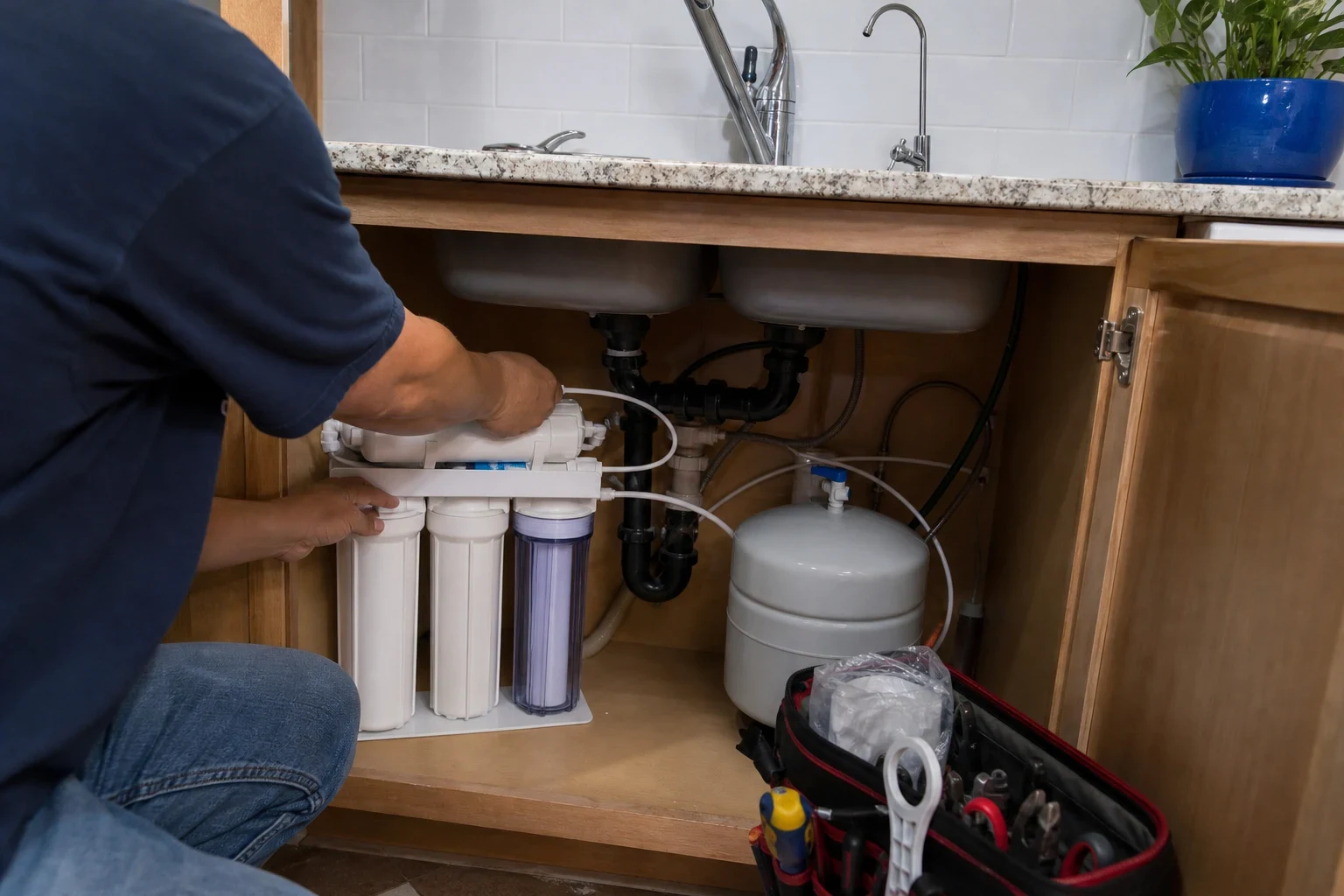
- We mount the filter housings and tank, tap the cold line with a feed valve, fit a drain saddle on the sink drain and drill or use an existing hole for the RO faucet. Standard professional installation is included for qualifying homes.
- Repair and filter service on existing units
- We change sediment and carbon cartridges, install fresh membranes, recharge the tank bladder and swap leaking fittings. We tell you if the housings or tank are too far gone to be worth saving.
- Pressure and output checks
- A membrane needs steady inlet pressure to produce well. We measure it, and if it runs low we discuss a permeate pump or booster rather than guessing.
- Refrigerator and ice maker lines
- When there is a clear route, we run a line from the RO tank to your refrigerator so the ice and dispenser water match the sink.
Signs Your Home Could Use Reverse Osmosis or RO Service
You buy bottled water for drinking
If the tap only gets used for dishes, an RO faucet usually pays its way in convenience alone.
Older plumbing or fixtures
Brass fixtures and older solder joints can add lead at the tap even when the utility water is fine. RO is one of the few home methods that removes it reliably.
The RO faucet trickles
A slow fill usually means a clogged sediment prefilter or a storage tank that has lost its air pressure. Both are fixable.
Water tastes flat, plastic or sour
A spent carbon postfilter or a tank that has sat too long can change the taste. We change the postfilter and sanitize the system before talking about anything bigger.
The drain runs constantly
If you hear water running to the drain long after the tank is full, the automatic shutoff valve or check valve has likely failed. It wastes water, and it is a small part to swap.
How an RO Visit Runs
- 1
Check the water and the cabinet
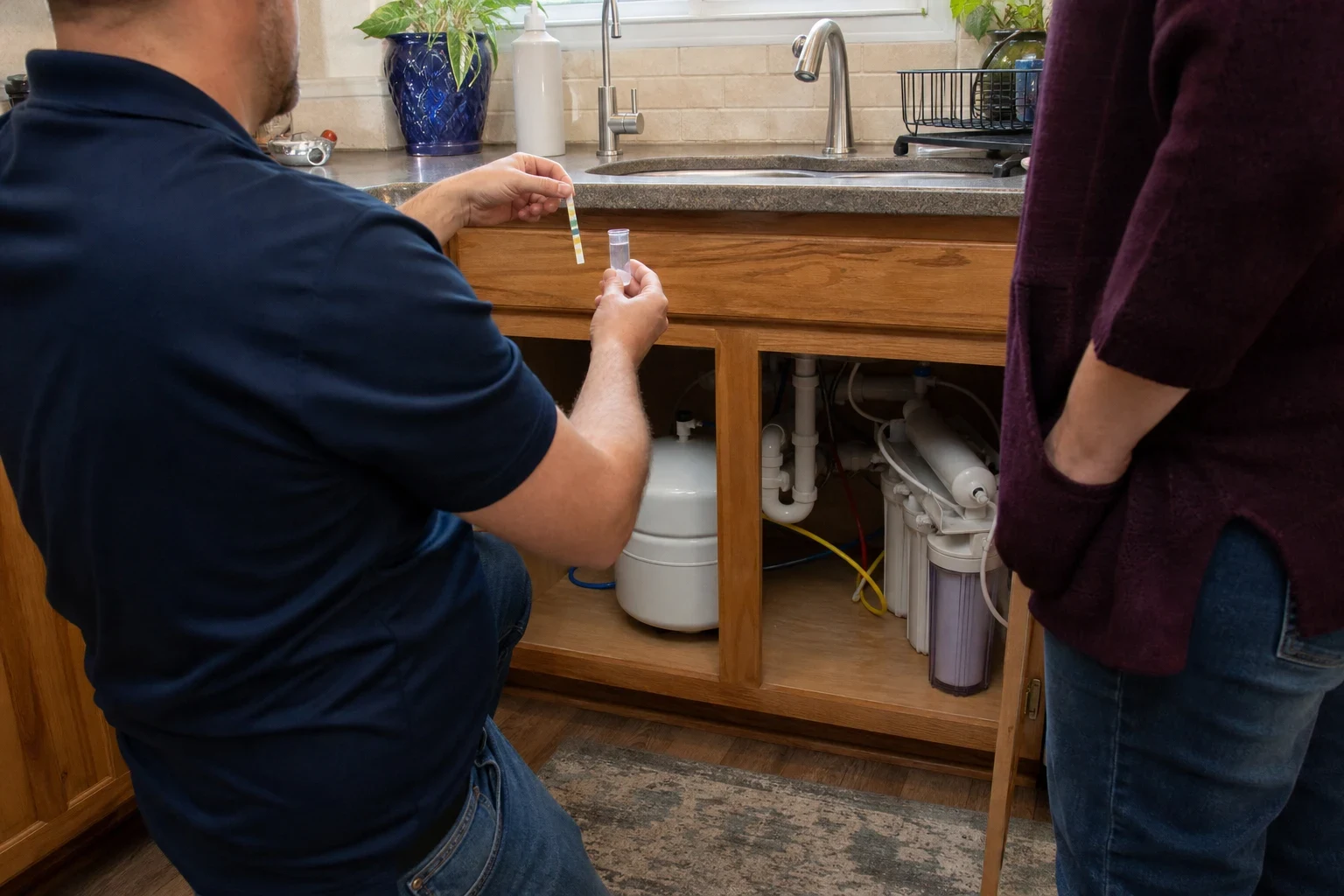
First we run a quick test on your tap water and look over the cabinet space, the cold supply valve and the drain line. On an existing unit we also read the tank's air pressure and compare the TDS of treated water against the tap.
- 2
Repair or replace, explained
We tell you which parts have failed and what fixing them involves. If the membrane, housings and tank are all worn, we explain why a new system is the better spend and give you a quote by phone or on the spot.
- 3
Install or service
We lay down a towel, clear the cabinet, fit the parts and pressure-test every compression fitting. A typical install fits within a few hours.
- 4
Flush and verify
We flush the first tanks to clear carbon fines and preservative from new cartridges, then read the TDS again so you can see the drop. We leave a filter schedule taped inside the cabinet.
What Moves the Cost of Reverse Osmosis
Repairs are priced by the parts they need, and that is often the cheaper path. New installs depend on the system and your kitchen. We give you a clear quote before any work starts.
- Repair or new system
- Swapping filters and recharging a tank costs far less than a new unit. A fresh membrane sits in between.
- Stage count and add-ons
- A standard four-stage setup sits at the lower end. Adding a remineralization cartridge, a UV stage or a permeate pump raises both the parts cost and the install time.
- Cabinet and countertop
- Drilling stone or quartz for the faucet takes more time and the right bit. A crowded cabinet with a disposal may need a compact tank.
- Extra lines
- Running a line to the refrigerator or a wet bar adds tubing, fittings and labor based on the distance and route.
Reverse Osmosis Questions We Hear
Something not covered here? (972) 284-7819
How often do the filters and membrane need changing?
Sediment and carbon prefilters usually last six to twelve months, depending on how much water you use and how dirty it is. The membrane commonly lasts two to five years. Changing prefilters on time is what protects the membrane, because chlorine and grit both shorten its life.
Does reverse osmosis waste a lot of water?
Some water always leaves through the drain line, because that flow carries rejected minerals off the membrane surface. The ratio depends on the membrane design and your inlet pressure. A working shutoff valve stops the flow once the tank is full, and a permeate pump can cut the waste noticeably on low-pressure lines.
Can you fix the RO system I already have?
Usually, yes. Most under-sink units use standard housings and membrane sizes, so we can source cartridges and parts for many brands. If the housings are cracked or parts are no longer made, we explain why replacement makes more sense.
Will RO water taste flat?
With most dissolved minerals stripped out, the water tastes lighter and crisper than plain tap water. Plenty of people prefer it that way. If you miss the old taste, we can fit a mineral stage after the membrane that returns a little calcium and magnesium to the water before it reaches the faucet.
Do I need a water softener with reverse osmosis?
Not always. Hard water scales the membrane faster, so the water test tells us whether hardness is high enough to matter. If it is, we will talk through water softeners with you, but we will not push one on soft water.
Find Out What Your RO Needs
Tell us whether you want a new system or have one that has slowed down. We will test your water and tell you plainly what it needs.